Will there still be coffee tomorrow? Tchibo calls for joint solutions for the future of coffee and cocoa
Hamburg,
- Dialogue event brings together politicians, NGOs, academia and consumer protection organisations
- The focus: how coffee and cocoa can continue to provide a future for millions of people working in agriculture, despite the climate crisis and price pressures
- Tchibo is expanding its “Coffee2Stay” programme and is committed to responsibility beyond certification labels
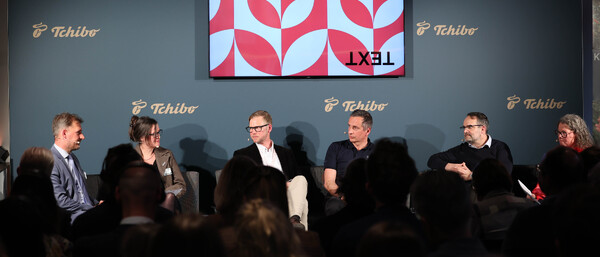
Berlin/Hamburg, 16 April 2026 – On 14 April, the future of two much-loved products – coffee and chocolate – was discussed in Berlin. Under the central question “Will there still be coffee tomorrow?”, Tchibo, together with Ritter Sport, brought key stakeholders from politics, civil society, academia, consumer protection and business together at the Data Space. The backdrop to this is the massive risks facing coffee and cocoa cultivation due to climate change, poverty and volatile global markets. Tchibo made it clear that, through its “Coffee2Stay” programme, the company aims to source all its green coffee responsibly by 2027, deliberately focusing not solely on certification labels but on direct impact at source.
Taking responsibility for a favourite product at a critical juncture
Coffee is considered one of the agricultural products most vulnerable to climate change. At the same time, coffee is a vital source of livelihood for millions of people. Similar challenges are emerging in cocoa cultivation.
“Whether there will still be coffee tomorrow is decided today on the farms where it is grown. If millions of people no longer have any economic prospects, our favourite drink has no future either,” said Pablo von Waldenfels, Director of Corporate Responsibility at Tchibo, in his opening remarks. “That is why, through our ‘Coffee2Stay’ programme, we are investing directly in more resilient farming methods and fair structures that go beyond mere certification schemes, and are working with partners in politics, civil society and business to develop prospects for the future.”
Tchibo is committed to taking direct responsibility within its supply chain
Tchibo has made a clear commitment to its responsibility at source. Through its coffee programme, the family-owned company aims to source 100 per cent of its green coffee responsibly by 2027. Tchibo already works with around 22,000 coffee farms in nine producing countries. Pablo von Waldenfels: “It is a new approach, a different approach: instead of outsourcing responsibility, for example by purchasing certified goods, we go directly into our supply chains, invest in adapting cultivation – for example to climate change – and in improving productivity and quality for the farmers, thereby laying the foundations for genuine sustainability in cultivation.”
Effect over symbolism
A key theme of the evening was the question of how sustainability can be credibly demonstrated. Tchibo emphasised that certifications have enabled significant progress, but cannot solve structural problems on their own. Precisely because a proprietary, impact-oriented approach requires explanation, trust plays a particularly important role. There was consensus that sustainable supply chains can only be established through long-term partnerships and investment at source.
Andreas Ronken, CEO of Alfred Ritter GmbH & Co. KG, emphasised:
“We source our cocoa not only from certified suppliers, but also through established programmes. Quality and the conditions under which people work can only be guaranteed if we visit the sites regularly. We have to go there; we have to be there. Our approach is similar to Tchibo’s – a challenging path that we have been following for a long time. We focus on concrete, long-term partnerships with local cooperatives.”
At the same time, Ronken was critical: the chocolate industry had, he argued, kept consumers in a marketing bubble for too long and had never really informed them about cocoa as a raw material (and the challenges associated with it). This is what is now causing a great deal of discontent among consumers over high chocolate prices:
“For a long time, the chocolate industry didn’t talk about cocoa. Instead, the focus was on Alpine milk, nuts or marzipan. Yet most people know more about wine-growing than they do about cocoa farming. The hard work of cocoa farmers has been far too little appreciated.”
A living wage as the key to transformation
Melanie Rutten-Sülz, Managing Director of Solidaridad Deutschland e. V., emphasised the importance of economic prospects for producers:
“We can implement many projects and activities to support farmers – for example, through training, productivity and quality improvements, or measures to ensure stable incomes. However, as long as there is no clear commitment to a living income and this is not firmly embedded in procurement practices, the systemic challenges will not be resolved.”
In doing so, she made it clear that sustainable change can only succeed if responsibility is embedded in the core business.
A reliable political framework remains crucial
The role of politics was also the subject of intense discussion. Dr Olaf Deutschbein, Head of the UNIDO Berlin Office, emphasised the importance of binding standards:
“The basic idea behind the Supply Chain Act was to establish a minimum standard so that responsible companies do not face a competitive disadvantage compared to those that do too little to combat child labour, forced labour or exploitative conditions, thereby keeping their costs down. Companies such as Tchibo and Ritter Sport, which are leading the way in their sectors, should not be disadvantaged by this.”
Despite understandable criticism of bureaucratic requirements, the objective remains central:
“Even if parts of the regulation are perceived as too bureaucratic, it remains crucial to eliminate such exploitative conditions and protect responsible companies.”
At the same time, Deutschbein highlighted the challenges facing consumers in the jungle of labels:
“Trust is needed. The multitude of labels is almost impossible for many to make sense of, and the term ‘sustainable’ is now being used inflationarily. That is why we need transparent and standardised criteria that provide guidance – without creating new bureaucracy. We at UNIDO are working on this at a global level.”
Consumer protection: transparency and trust provide guidance
Markus Kamrad, Director of the Berlin Consumer Advice Centre, assessed these efforts from a consumer perspective:
"I understand why companies are going their own way, beyond certification schemes, adopting approaches that may seem unconventional at first, in order to tackle sustainability challenges."
At the same time, he warned against placing the responsibility solely on consumers:
“There is no such thing as a fully informed consumer. Labels are therefore an important guide – insufficient, but currently the best we have. At the same time, I can understand when companies say that labels are not enough. But this makes communication difficult.”
Shared responsibility for the future of coffee and cocoa
The discussion made it clear that the transformation of global supply chains can only succeed if we work together. Businesses, policymakers, civil society and consumers all share responsibility.
- You can find documentation on the event (including videos, a magazine and reports) here: KLARTEXT | Tchibo Dialogue Event
- Coffee Magazine: What the future needs
Attached image (from left to right):Dr. Olaf Deutschbein, Melanie Rutten-Sülz, Pablo von Waldenfels, Andreas Ronken, Vern Long, Karel J. Golta, Markus Kamrad, Katja Weber (Moderation
More information for journalists:
Sandra Coy, Sprecherin Unternehmensverantwortung & Qualität
Phone: +49 40 6387-2818
E-Mail: sandra.coy@tchibo.de
About Tchibo:
Tchibo stands for a unique business model. The company uses its multi-channel distribution system to offer coffee and the Cafissimo and Qbo single-serve system, along with weekly changing non food ranges. In eight countries, Tchibo operates about 900 Tchibo shops and national online shops. The company is also represented in around 16,000 Depots at third-party retail outlets throughout Germany, of which around 8,000 also sell consumer goods. Founded in Hamburg in 1949, the family-owned company generated sales of 3.36 billion euros in 2024 with 10,452 employees worldwide. Tchibo is the roasted coffee market leader in Austria, the Czech Republic, Germany and Hungary and one of the leading e-commerce companies in Europe. Its sustainable business policies have earned Tchibo multiple national and international awards.