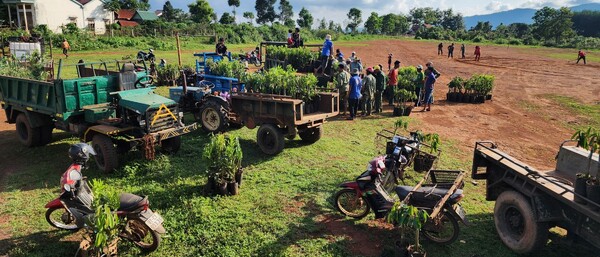
Two years of the coffee programme are showing results: Already 22,000 farms in nine producing countries have been reached
Hamburg,
• Reached 22,000 coffee farms in nine producing countries
• Focus: securing livelihoods, strengthening climate resilience, measuring impact
• Target for 2027: 100 per cent responsibly sourced green coffee (currently 27 per cent, by the end of 2026: 40 per cent)
Hamburg, 14th April 2026 – Two years after its launch, Tchibo’s “Coffee2Stay” programme is having a tangible impact at source: the Hamburg-based family business now works with around 22,000 coffee farms across nine producing countries – significantly more than last year. The focus is not on standards on paper, but on clear, measurable improvements on the farms.
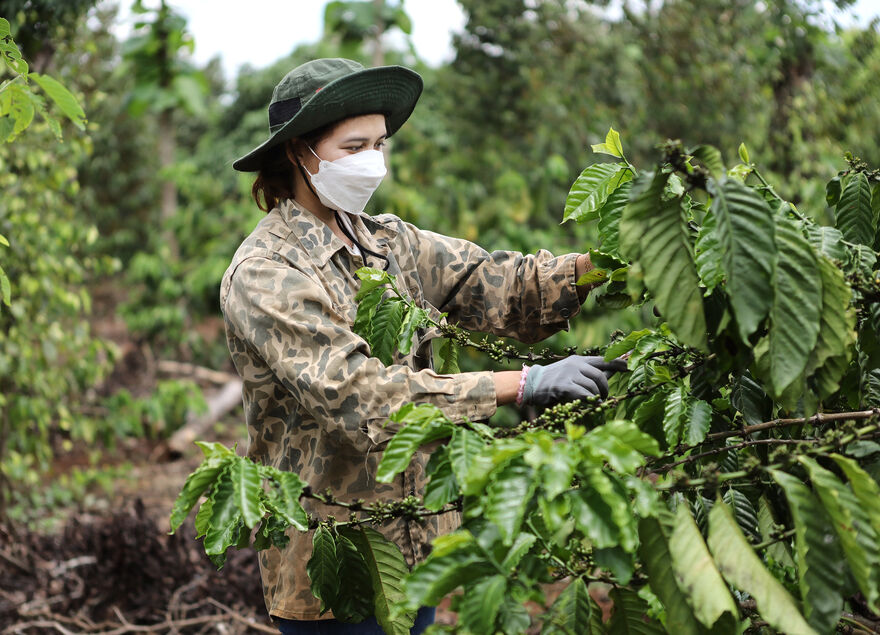
Nine countries of origin, tailor-made programmes on the ground
Seven countries of origin are supported through Tchibo’s own coffee programmes, tailored to local challenges, whilst two others are supported through partner programmes. Tchibo currently works with coffee farmers in Brazil, Honduras, Indonesia, Guatemala, Kenya, Peru, Tanzania, Vietnam and Uganda.
All programmes are based on independent, methodologically sound risk analyses conducted by the organisation Enveritas. These analyses identify where environmental, social and economic risks are particularly high – and where targeted measures must be implemented. Building on this, Tchibo works with local partners to develop programmes tailored to specific needs: from income security and climate-resilient farming methods to the protection of biodiversity.
“The root cause of many sustainability issues in coffee farming is poverty, not a lack of will. That is why we focus on areas where the economic foundations are lacking,” says Pablo von Waldenfels, Director of Corporate Responsibility at Tchibo.
Focus on the critical parts of the supply chain
The majority of coffee grown worldwide is not certified. Tchibo deliberately focuses its efforts on these areas.
Key areas of focus include water management, soil quality, child labour, biodiversity and the inclusion of women. The economic foundation remains central: only when farms are financially stable can they invest in climate and environmental protection.
“The key question is: what happens outside the certified supply chains?” said von Waldenfels. “That is precisely where we want to take responsibility, because it is about safeguarding our raw materials. We are not turning our backs on external auditing – but on the idea that a certification mark alone guarantees effectiveness.”
The coffee scheme complements existing schemes where these reach their structural limits.
Progress at source: the examples of Kenya and Peru
In Kenya, Tchibo is working with local cooperatives in the Kirinyaga region on climate-resilient farming. This includes training in sustainable farming methods, setting up nurseries, and the targeted involvement of women and young people.
In Peru, the focus is on the Junín region. There, Tchibo, together with its partner Perhusa, will support around 1,800 farmers over the coming years with training on productivity, quality and climate-resilient farming. The background to this includes risks posed by poverty, soil erosion and declining yields.
Transparency and verification as a fundamental principle
Tchibo regularly commissions the organisation Enveritas to review the implementation and effectiveness of its measures. The focus is not on formal documentation, but on whether the measures are actually being implemented and having an impact.
“Enveritas doesn’t verify certificates, but our work,” says von Waldenfels. “Are training sessions taking place? Are they relevant? Is anything changing on the farms?”
Scaling up - from 27 per cent to 100 per cent
Aktuell stammen rund 27 Prozent des Rohkaffees aus verantwortungsvollem Einkauf. Bis Ende 2026 sollen es 40 Prozent sein, bis 2027 die gesamte Menge.
Outlook: Coffee with a future
Tchibo’s coffee programme is designed for the long term. Over the coming years, Tchibo aims to further expand its reach to a total of 80,000 farms, strengthen existing programmes and include additional countries of origin.
“If we want to continue drinking coffee in the future, we must act now,” said von Waldenfels. “Our aim is to take responsibility across the entire supply chain for all our coffees – even where things get complicated and uncomfortable.”
More information for journalists:
Sandra Coy, Sprecherin Unternehmensverantwortung & Qualität
Phone: +49 40 6387-2818
E-Mail: sandra.coy@tchibo.de
About Tchibo:
Tchibo stands for a unique business model. The company uses its multi-channel distribution system to offer coffee and the Cafissimo and Qbo single-serve system, along with weekly changing non food ranges. In eight countries, Tchibo operates about 900 Tchibo shops and national online shops. The company is also represented in around 16,000 Depots at third-party retail outlets throughout Germany, of which around 8,000 also sell consumer goods. Founded in Hamburg in 1949, the family-owned company generated sales of 3.36 billion euros in 2024 with 10,452 employees worldwide. Tchibo is the roasted coffee market leader in Austria, the Czech Republic, Germany and Hungary and one of the leading e-commerce companies in Europe. Its sustainable business policies have earned Tchibo multiple national and international awards.