20 Years of Sustainability at Tchibo
Since 2006, responsibility and sustainability have been an integral part of our business strategy, our DNA and our actions. Today, 20 years on, we are taking a look back at two decades in which we have achieved a lot: our human rights programme WE, circular economy projects, the further development of our coffee programme, the validation of our climate strategy – and much more besides. Twenty years is therefore a real milestone that fills us with pride.
And yet we remain honest with ourselves. A few years ago, we wrote in our sustainability report: ‘We are part of the problem – but we want to be part of the solution.’ Today we can say: in some areas, we have in fact already become part of the solution, for example through our involvement in initiatives such as ACT and WCR, or our programme work with ‘Coffee2Stay’ and WE. In other areas, we haven’t quite got there yet. But we have a plan. A plan based on listening, transparency and the courage to try new things.
Sustainability is not a project. Sustainability is our way forward.

How it all began...
We’re taking you on a little journey through time! It all began in 2005, when activists from the ‘Clean Clothes Campaign’ turned up on our doorstep: seamstresses from Bangladesh were protesting to draw attention to the appalling working conditions in the subcontracting workshops and textile factories. Shaken into action by this campaign, we realised that, up until then, we hadn’t paid enough attention to the social and environmental impacts of our actions throughout the supply chain. We quickly decided to systematically identify human rights risks in our supply chains and develop concrete measures. This marked the beginning of our transformation into a responsible company. This transformation does not happen overnight. It is an ongoing process that is constantly evolving and can, in retrospect, be summarised in three phases:
- Recognising and fulfilling responsibility (from 2005): Tchibo is forced to take action and must respond to socio-political demands.
- Tchibo is leading the way (until the end of 2023): Tchibo is setting up a sustainability team and taking responsibility for key areas.
- Integration into the core business (from 2024): Sustainability will be integrated into the core business with clearly defined areas of action and targets.
„Clean Clothes Campaign“ against Tchibo
„Clean Clothes Campaign“ against Tchibo
Start of our work on the WE programme
Start of our work on the WE programme
Switch to plastic-free textile packaging
Switch to plastic-free textile packaging
First recyclable coffee packaging
First recyclable coffee packaging
SBTi-Validation of our climate targets
SBTi-Validation of our climate targets
Responsibility as an integral part of our business strategy
Responsibility as an integral part of our business strategy
Signing of the Greenpeace DETOX Commitment
Signing of the Greenpeace DETOX Commitment
Switch to 100% sustainable cotton
Switch to 100% sustainable cotton
Launch of the Tchibo coffee program
Launch of the Tchibo coffee program
20 years of responsibility at Tchibo
20 years of responsibility at Tchibo
20 Years - 20 Theses
Over the past 20 years, we have learnt a lot about what is required for industry transformation and organisational change. We have achieved a lot since then, but there is still much to be done. We are taking our 20th anniversary as an opportunity to look back, but above all to look ahead. What have we learnt about sustainability over the past 20 years? And what lessons can we take forward into the future? We have summarised our insights and lessons learnt from two decades in 20 theses. These theses are not definitive answers, nor are they a set of rules for sustainability. They are thought-provoking ideas, conversation starters and fresh perspectives designed to help us shape the future. They are intended to inspire, provoke and challenge – and, above all, to encourage us to engage in dialogue with one another.
01 |

Change must not be an excuse
Sustainability is constantly evolving. This challenges us to keep developing new solutions. What remains constant is that sustainability requires visible progress, clear responsibilities and the courage to make decisions.
02 |

Impact is the most important driving force
What motivates us: we want to achieve measurable and tangible improvements – for people, the climate and the environment.
03 |

Without targets, sustainability remains nothing more than a good intention
Clear KPIs, transparent management and accountability at executive level determine whether sustainability remains a priority or a secondary concern.
04 |

Sustainability isn't achieved through PowerPoint presentations
Targets and pilot projects are important. But real impact is only achieved when we invest in them consistently and continuously, put them into practice and further develop them.
05 |

Perfection can stand in the way of progress
Getting started, experimenting, taking action: prototyping and iterative implementation lead to greater progress than striving for the perfect solution.
06 |

Trust is the foundation
Sustainable transformation can only succeed in a culture where people feel secure and are happy to take on responsibility.
07 |

A willingness to change is a key skill for the future
Transformation succeeds when people are willing to learn, try new things and continually develop their skills.
08 |

Sustainability is not the responsibility of a single department
Sustainability is achieved every day and wherever people within the organisation make decisions. That is why employees and cross-departmental collaboration are a crucial lever.
09 |

Respectfully and on at equal footing
Sustainable solutions are not developed for, but with, the people they affect. This ensures that existing knowledge is taken into account and that the necessary acceptance is built up to make measures effective in the long term.
10 |

Competitors in the markets, partners for more sustainability
When companies pool their commitment to sustainability, strong networks emerge that enable change across the whole industry and throughout the country.
11 |

We often don't come up with the best ideas ourselves
Innovation doesn't necessarily mean always inventing something new. Often, effective solutions already exist. Our task is to identify them, take them seriously, develop them further with our partners and make them scalable.
12 |

Thinking globally, acting locally
Sustainability strategies are effective when they are individually designed, tested on the ground and adapted to the specific context. Local knowledge, cultural characteristics and proximity are the key to genuine relevance and long-term integration.
13 |

A company's attitude becomes apparent in difficult times
How seriously companies take sustainability is not revealed in good years, but rather when budgets come under pressure, social trends shift or uncertainty increases.
14 |

Fairness requires reliable rules
Reliable legislation provides guidance for economic activity. It forms the universally applicable basis on which human rights, environmental protection and climate protection become an integral part of economic processes.
15 |

Transparency is the currency of credibility
Facts and self-criticism are more effective than fine words: an open approach to progress, setbacks and unresolved issues fosters a culture of honesty, builds trust and encourages dialogue.
16 |

Without economic viability, there can be no sustainability
Only if we operate profitably can we invest in sustainability. And only if sustainability also pays off financially, we can win the people and business partners in our supply chains as allies.
17 |

External impulses acclerate transformation
Critical campaigns served as a catalyst for sustainable transformation at Tchibo. After some initial unease, we learnt that even headwinds can drive us forward, and that dialogue is crucial to a successful transformation.
18 |

Data provides orientation
For decades, the sustainability agenda was driven forward by individual organisations and campaigns. Today, data helps us deploy our limited resources toward the most relevant issues and in the right places.
19 |

Don't overwhelm consumers
Our customers want both: products at a good price and a company that acts responsibly. It is our job to make this possible and thereby relieve customers of the burden of individual responsibility.
20 |

As a company, we have a responsibility
If price sensitivity and sustainable purchasing decisions are the new normal, our product range must reflect this. Right from the product design stage, we must ensure that sustainability requirements and price sensitivity do not come into conflict.
Podcast "5 Tassen täglich"
20 years of sustainability at Tchibo: We taking a look back and reflecting on the past two decades
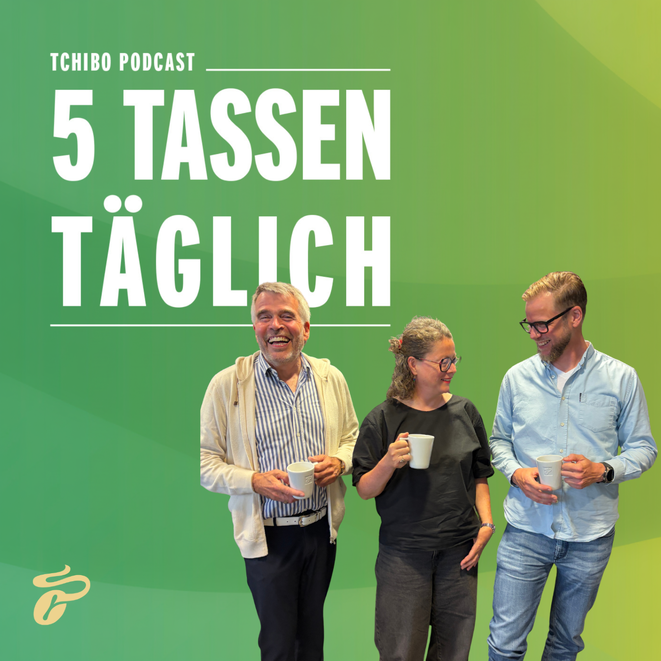
In the latest episode of our Tchibo podcast, "5 Tassen täglich", two acknowledged Tchibo sustainability experts are sitting down together today: We speak to Achim Lohrie, who founded the sustainability department at Tchibo in 2006 and, 20 years ago, paved the way for a new understanding of corporate responsibility within the family-owned business, and with Pablo von Waldenfels, who heads the division today and is currently responsible for the further development and implementation of Tchibo’s sustainability strategy as a change-maker in an era characterised by regulation and sustainability fatigue. What is the perspective on the past and the present? Does this exchange tend to reveal common ground, or do we see representatives of two generations who, both yesterday and today, are – or have been – committed to the same cause, yet could not be more different in every other respect? This podcast episode is hosted by Katja Weber, an rbb journalist from Berlin. Listen now!
Voices
A look back over the last two decades: What do we say ourselves? What do others say? In our latest “what the future needs” magazine, which also features the voices shown here, we and various colleagues take a look back. Honestly and unfiltered … what has Tchibo done well in recent years? What could have been better? Do have a look at the magazine and discover further perspectives.
"When it comes to sustainability, there’s never just one right way; instead you have to keep trying new things and also admit when something isn’t working. That’s the only way to make progress towards greater sustainability."
Achim Lohrie, Pioneer and Founder of Tchibo’s sustainability department in 2006, p. 43
"In the past, the issue of sustainability at Tchibo was largely driven from outside. The company reacted to criticism and attacks. Today, the focus has shifted in-house. Sustainability is part of our corporate philosophy..."
Pablo von Waldenfels, Director of Corporate Responsibility, Tchibo, p. 42
"Today, 20 years later, it is clear that Tchibo has taken many positive steps: [...] Despite many positives initiatives in recent years, fundamental problems in the supply chains persist. [...] There is therefore still much to be done – in sales, in garment manufacturing and in the upstream processing stages."
Dr. Gisela Burckhardt, FEMNET/CCC, p. 55ff.
"That’s one thing we’ve definitely learnt from our sustainability work: nothing is as important as seeking dialogue – with NGOs, with the people who work in our supply chains – and especially with our critics."
Monika Focks, Corporate Responsibility Specialist, Tchibo, p. 12
Learn more!
Additional information and materials available for download. To read on your own and share with others.
Upon request, the magazine "what the future needs" and the card game "20 Theses" are also available in print and can be mailed to you. Feel free to send us a message.
Card game "20 Theses"
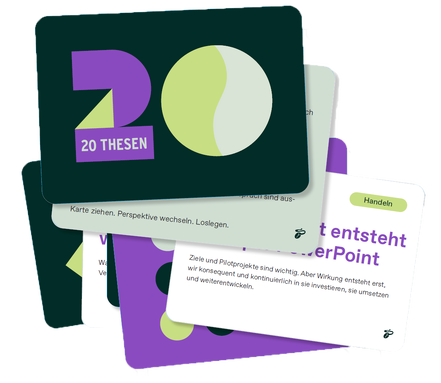
We have compiled our 20 theses into this set of cards. As a high-quality printed product, they are designed to bring sustainability into our thoughts and conversations. They invite us to pause, question our habits, shift our perspectives, and shape the future together. Because change happens when we talk about it and take action. Whether alone, in pairs, or in a group: Draw a card and share your thoughts. What do these statements trigger in you? Where do you agree, and where do you disagree? Different perspectives and disagreements are expressly encouraged. Draw a card. Change your perspective. Let’s get started!
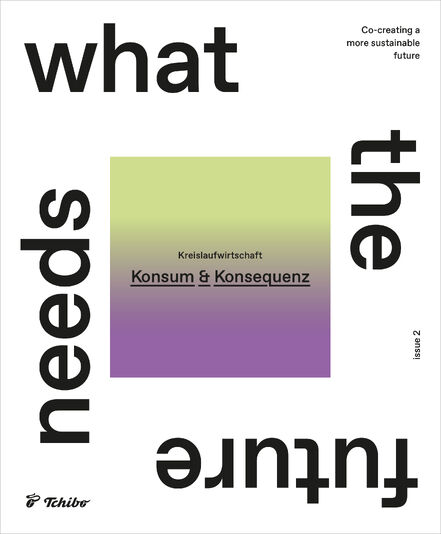
The new issue "what the future needs"
Have you heard of our magazine series “what the future needs”? This series focuses on socially and environmentally relevant topics that inspire reflection and provide valuable insights. The idea and goal of this magazine is to explore current sustainability topics with internal and external experts. Bringing together different perspectives fosters a critical and honest exchange on equal footing. The new issue of “what the future needs” is already in the works: It is titled “Consumption & Consequences” and focuses, among other things, on topics related to the circular economy. The issue is expected to be available starting in November 2026.
Press release
To mark our 20th anniversary, we have issued a press release.