20 years of sustainability
Hamburg,
- 2006: Crisis.
- 2026: Sustainability as the norm.
- 20 years of progress and setbacks.
- Achim Lohrie, a sustainability manager from the very beginning, and Pablo von Waldenfels, Director of Corporate Responsibility, discuss campaigns, sustainability as a sales incentive or a stumbling block, and securing the future.
Hamburg, 26 October 2026 – It was not a happy occasion. In 2005, Tchibo hit the headlines because of working conditions in textile factories: The Clean Clothes Campaign denounced human rights violations in factories where Tchibo also had goods manufactured. This marked the starting point in 2006: the Hamburg-based family business decided to fundamentally rethink its approach to sustainability and integrate it into its business operations.
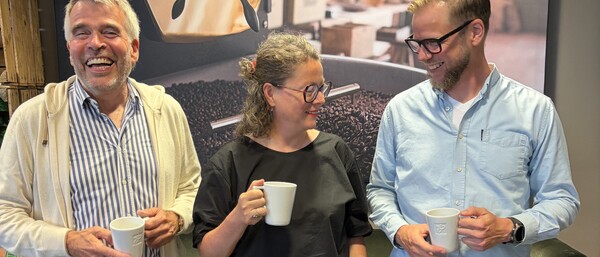
In the latest episode of the Tchibo podcast ‘5 Tassen täglich’, two people who have played a key role in shaping this development look back and look ahead: Achim Lohrie, who joined Tchibo in 2006, established the Corporate Responsibility division and led it until 2019, and Pablo von Waldenfels, Director of Corporate Responsibility since 2022. In conversation with host Katja Weber, they take stock of the situation so far.
You’ve got a problem – can I help?
Lohrie recalls how, in 2006, as a self-employed consultant and former Otto manager, he followed the news coverage of Tchibo: “I sat in front of the television, stunned, watching Tchibo being torn to shreds. As a young, dynamic entrepreneur, I simply rang Tchibo and said: ‘I think you’ve got a problem. Can I help you?’"
Consequently, the initial focus in 2006 was on crisis communication. And: “Networking, networking, networking”. This was followed by the development of a strategy, in consultation with activists from the Clean Clothes Campaign and Greenpeace – both NGOs had dragged Tchibo into the public spotlight. To this day, von Waldenfels continues to prioritise dialogue: “One of the strengths of the Tchibo approach is not always wanting to do everything on our own, but rather engaging in dialogue, opening the door and keeping the lines of communication open.”
From a campaign to the norm
WE Human Rights Programme in non-food factories, climate management, the 2014 Detox pledge, the 2016 German Sustainability Award: this podcast episode traces the key milestones. For von Waldenfels, it is primarily the role of the issue that has changed: “Sustainability has gone from being a campaign to becoming the norm.” What was once brought to the company from outside is now part of its core processes. In the coffee sector, Tchibo is relying on Coffee2Stay, a data-driven programme that works with local coffee farmers to develop improvements. When asked what helps people in the supply chains the most, von Waldenfels is clear: “A decent income is the most important factor.”
What customers pay for – and what they don’t
Lohrie and von Waldenfels dispel the expectations that once surrounded sustainability. Achim Lohrie: “Don’t count on us earning even a single extra cent from sustainable products.” Von Waldenfels: “I think, in part, people were building castles in the air; with the idea that, in future, everyone would only buy sustainably and would also be prepared to pay more for it. I don’t think that was ever really the case.” He explains why the issue still matters as follows: “Food is a trust-based commodity. People want to know: I’m buying from a responsible company.” And Lohrie, who describes himself as “a businessman, not an NGO”, turns the question on its head: what matters is not whether a company can afford sustainability, but whether companies can still afford not to invest in it. “They’ll simply disappear from the market at some point.”
Being open about setbacks
Over 20 years of sustainable business operations, there have been (and continue to be) setbacks. According to Pablo von Waldenfels, one challenge is finding reliable project partners in the countries of origin who can keep up with the desired pace of the coffee program.
Even when it comes to living wages and incomes, Achim Lohrie believes the industry is not making progress quickly enough, both in the factories and in coffee cultivation. “We’ve already tried out so many programs here within the stakeholder network. And we’re still discussing it.”
A look ahead to 2036
Von Waldenfels identifies two key priorities for the next ten years: securing the future of coffee cultivation so that “we can really see changes in the regions where we and others are working”. It is just as important, he says, that circular products and services finally become a visible part of the core portfolio. “I think circular business models, such as recyclable ‘textile-to-textile’ solutions, are, at the end of the day, the future.” Lohrie concludes by expressing his hope for a prestigious award: “In ten years’ time, I’d love to see Tchibo win the German Environmental Prize.”
Take Aways
“Perhaps the most important lesson from 20 years of sustainability is this: give things a go. Just do it. Don’t wait for the perfect solution. If necessary, put the issue to one side for a while. Never stand still.” Pablo von Waldenfels
“If you think something won’t work, you’ll usually be proven wrong – provided there’s the necessary drive and energy behind it. And that means working together with others, not alone.” Achim Lohrie
- Episode #150 of ‘5 Tassen täglich’: ‘From a crisis to a core business: 20 years of sustainability at Tchibo’ is available on all major podcast platforms and here.
- Further information on the 20th anniversary can be found here.
More information for journalists:
Sandra Coy, Sprecherin Unternehmensverantwortung & Qualität
Phone: +49 40 6387-2818
E-Mail: sandra.coy@tchibo.de
About Tchibo:
Tchibo stands for a unique business model. The company uses its multi-channel distribution system to offer coffee and the Cafissimo and Qbo single-serve system, along with weekly changing non food ranges. In eight countries, Tchibo operates about 900 Tchibo shops and national online shops. The company is also represented in around 16,000 Depots at third-party retail outlets throughout Germany, of which around 8,000 also sell consumer goods. Founded in Hamburg in 1949, the family-owned company generated sales of 3.36 billion euros in 2024 with 10,452 employees worldwide. Tchibo is the roasted coffee market leader in Austria, the Czech Republic, Germany and Hungary and one of the leading e-commerce companies in Europe. Its sustainable business policies have earned Tchibo multiple national and international awards.