Ritter Sport and Tchibo: Solutions rather than problems
"what the future needs“
Our magazine series focuses on societal, sustainable, and socially relevant topics designed to inspire and provoke thought. The aim is to explore current sustainability issues critically and sincerely with internal and external experts.
Today’s Focus:
A conversation – Ritter Sport and Tchibo: Solutions rather than problems
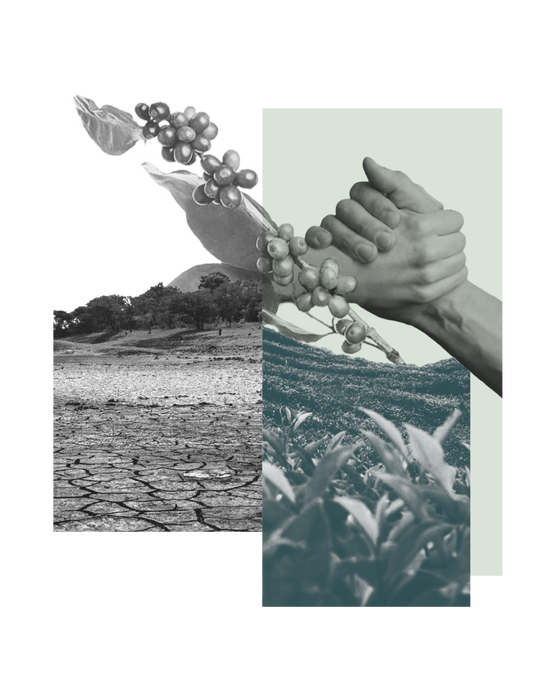
The chocolate company Alfred Ritter, known for its Ritter Sport brand, grows its own cocoa, relies on sustainability certificates and runs its own programmes. The company Tchibo has restricted the use of certificates for its coffee range and is investing in partnerships with coffee farmers. A conversation about whether the cocoa and coffee industries are comparable – and what they can learn from one another.
In 2012, Ritter Sport began establishing its own cocoa plantation, El Cacao, in Nicaragua. What was the motivation back then?
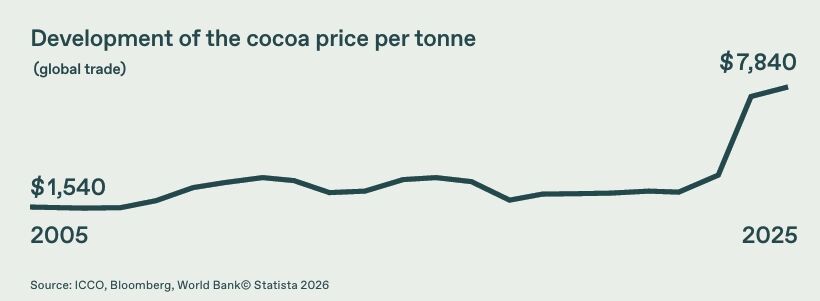
HAUKE WILL: To answer that, we need to look back to 2010 and 2011. Back then, it was difficult to source reliable cocoa of consistent, good quality. The second reason was that prices were extremly volatile. Today we would be happy with such ‘mi nor’ fluctuations, but ten to twelve years ago, an nual price swings of up to USD 1,000 per tonne were a massive problem. These instabilities in price and quality were the impetus to consider whether we should set up our own production and thus stabilise our supply, at least to some extent. The third aspect, which was just as important, was the issue of sustainability
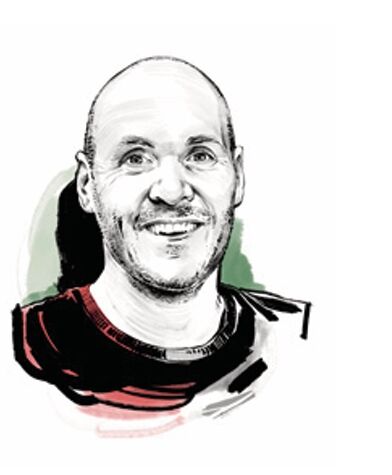
HAUKE WILL
ALFRED RITTER GMBH & CO. KG
Hauke Will is Head of Agricultural Production at Alfred Ritter. In this role, he is responsible for the com pany’s own cocoa planta tion in Nicaragua, two ha zelnut farms and the further development of agricultural production.
PETRA FIX: Back then, there was hardly any transparency in the cocoa supply chain. There were many issues regarding sustainable cocoa farm- ing that were rightly viewed very critically. Our aim as a company was to produce chocolate where we could say with certainty that the cocoa used had been sustainably produced. That’s why we decided, let’s just do it ourselves.
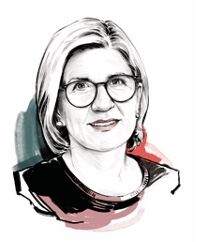
PETRA FIX
ALFRED RITTER GMBH & CO. KG
Petra Fix is responsible for sustainability communi cations at Alfred Ritter and has been familiar with the topic of cocoa supply chains for many years.
Back then, you set yourselves the goal of producing at least 20 to 25% of the cocoa needed for your production on your own plantation. Did that work out?
HAUKE: We haven’t quite reached the 20% mark yet. There are several reasons for this. The cocoa plant grows slowly and needs a certain lead up period before it becomes fully productive. And we are an industrial company that has ventured into agriculture. But agriculture doesn’t have the predictability that we’re used to, for example, in a closed production facility. In agriculture, there are factors that sometimes turn life a bit upside down. However, we’re still sticking to the 20% target.
Could that also be an approach for Tchibo? A large-scale plantation of our own, moving away from the nitty-gritty of the small-scale and the complicated supply chains?
PABLO VON WALDENFELS: We are taking our first steps in this area. Tchibo, for example, has a stake in a farm in Brazil and one in Tanzania. Overall, however, Tchibo sources coffee from almost a dozen countries – not just to spread the risk, but above all to be able to offer our customers a wide range of flavours, varieties and qualities. Covering this range on a large scale ourselves is certainly conceivable, but it would also be a very long journey.
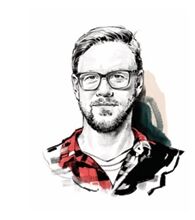
PABLO VON WALDENFELS
TCHIBO GMBH
Pablo von Waldenfels is responsible for corporate responsibility at Tchibo.
PETRA: 20% of cocoa from our own production might sound like a lot. We continue to source the other 80% of our cocoa mass – and we also need a great deal of cocoa butter – from many, mostly small suppliers. With co coa, too, the majority – 95 to 98% – comes from smallholder production. That’s the beauty of both raw materials: it’s all about quality, sensory diversity and, consequently, different places of origin.
Looking at smallholder structures, where are the major challenges currently in both supply chains?
PABLO: Running a small farm profitably is incredibly difficult in agri culture. This isn’t just true for coffee or cocoa. Even in northern Germany, a re gion with a highly professionalised agricultural sector, it’s hard to run a farm of 15 hectares. When it comes to coffee, in many countries we’re talking about plots of half a hectare to one and a half hectares. Supporting a family on that is really, really hard – and almost impossible to manage on coffee alone.
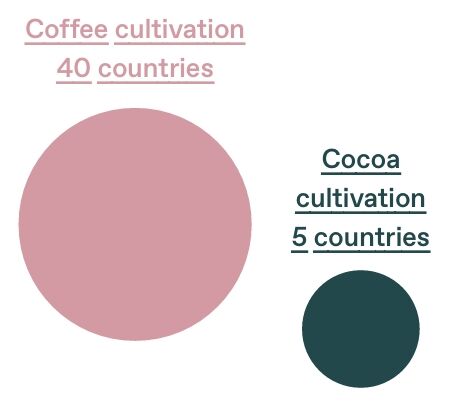
HAUKE: In small-scale farming, we face similar challenges, but there is also a major difference. In cocoa farming, there are two countries that have a regulated state market and a regulated pricing policy – Ghana and the Ivory Coast. There, even in periods of high prices, cocoa farmers are unable to stabilise their economic situation or improve their circumstances. We source cocoa from five coun- tries – Nicaragua and Peru in Latin America, Nigeria, Ivory Coast and Ghana in Africa. Peru – like all other unregulated markets – has benefited immensely from the high prices of the last 24 months. This has allowed farmers to invest in their farms. In regulated markets, however, in Ghana for example, this has not worked. This means that, despite high world market prices, farmers there have been unable to build up reserves. I do not know if there is a similar regulatory framework in the coffee sector, but I see this as a major challenge for a smallholder sustaina bility approach.
PABLO: In the coffee sector, this kind of state regulation does not exist. The basis is always the exchange price, and then there are additional regional differentials for quality, demand, sustainability and so on. Yet even in coffee, higher prices do not automatically mean more profits for farmers – the more middlemen there are, the less is left for the farmers. The exchange rate also plays a role. And labour costs are rising – for pickers, for example. When they know that market prices are high, they naturally want their share of the pie too. The war in Ukraine has also made fertilisers more expensive – so there are a whole host of additional factors that affect farmers’ profits. However, in regions where there is actually some profit left over, we are seeing increased investment in coffee farms. I was recently in Honduras – the plantations there are visibly better main tained, and the plants are healthier. A lot is happening.
As well as your own farm and origin programmes, there is also the option of relying on sustainability labels. Do you see this as a useful addition to your commitment?
PETRA: We launched our first own source programme in Nicaragua back in 1990 and were long convinced that we didn’t need external labels – we simply didn’t want to rely on them. Instead, we developed our own labelling system. Over time, however, we realised that our customers didn’t really know what to make of it. There was a lack of immediate connection – which certainly isn’t im mediately apparent in the link between cocoa and chocolate either. Whilst we were always able to provide detailed evidence of our commitment, this requires consumers to take the time to under- stand the background. That willingness may be greater today. Nevertheless, we did eventually opt for external certification and labels. Today, we require either Fairtrade or Rainforest Alliance certification as a basic requirement for our cocoa sourcing. We then build on this with our own programmes.
Does this mean your focus in sustainability is on your own projects and your own cultivation, but be cause it’s too complex to convey that to consumers, you use labels?
PETRA: I think that’s putting it too simply. Certifications not only offer our consumers guidance; more importantly, they provide farmers with an opportunity to professionalise their farming practices. At the same time, however, they are not dependent on us, so they can sell to whoever they want. That’s important to us, because these aren’t ‘our’ farmers, but free, independent trading partners in the supply chain.
Pablo, how does that work in your projects? Are they ‘your’ farmers who have to sell to you?
PABLO: We, too, do not want coffee farmers to be tied to us as buyers through programmes. All these considerations regarding uniform standards, comparability and flexibility have, of course, been part of our thinking as well. And until recently, we were also buying more certified coffee. But we have changed that. Perhaps a brief look at the history would be useful here. When Tchibo first started looking at sustainability in coffee, we began by asking: What certifications are already available? What is on the market that we can build upon? We then realised that there simply wasn’t enough certified coffee on the market to meet the volumes Tchibo wanted to purchase. The second realisation was that before farmers or cooperatives can be certified, they need to invest – in man agement systems, documentation and training. That costs money that many smallholders simply do not have. That is why we said we need projects that enable these investments and support farmers in establishing the necessary structures. That was the starting point for our project work. And over time, this has developed into much more: a comprehensive commitment to better growing conditions, higher yields and more stable incomes.
In short: your own coffee programme, which you are now implementing inde pendently.
PABLO: Although we have now parted ways with Rainforest Alliance and Fairtrade, we are of course not doing away with external audits and uniform standards. We now work with Enveritas, an NGO that has its roots in project work. They identify areas where action is needed and audit our programmes – and those of other companies. We believe that this approach allows us to work in a more target ed way and achieve greater impact. Certifications would represent duplication of effort for us. Which doesn’t mean that we won’t continue to work with certification bodies in our projects. The challenge we currently face is how to communicate our commitment to consumers with out labels? We’re presently right in the middle of that now.
Does that mean to communicate sustainability credibly to consumers, we need labels – even though there is a risk that this could slow down the company’s own programmes?
PABLO: Which measures really work? There are numerous stakeholders – including many consumer advocates – who place great value on established labels, precisely because they have been around for years. We find that these stakeholders often struggle with new forms of commitment, such as company-specific programmes. We frequently encounter a certain bias here and little willingness to engage with alternative approaches. An interesting observation that gives us hope is our customers not placing any more trust in established labels than they do in our statements about our own programmes. This encourages us to continue working intensively on gaining acceptance for our approaches. For we are convinced that, if pursued seriously and properly validated, they are at least as effective as established labels.
HAUKE: I also believe that company-specific programmes are necessary and very effective. On the other hand, we also see that when you focus on programmes, the critical question always arises: Why do you run your own programme and do not measure yourself against the standards that already exist? And so, for us at the moment, a good solution is to say that we do a) certification according to standards and b) ‘Beyond Certification’, i.e., our own programmes, which, in our view, offer much greater added value for farmers.
PETRA: I believe there is also a big difference from the consumer’s perspective between chocolate and coffee. Chocolate is an impulse buy. That means consumers reach for the product much more spontaneously and, in return, a glance at the seal provides guidance and a good gut feeling: regardless of how meaningful it is in depth, it creates credibility.
PABLO: Interesting point. With coffee, there are also impulse buyers who mainly buy coffee when it’s on offer. But there are also many consumers who have a set of brands they like to buy and want to trust. It is becoming increasingly important to many consumers that their preferred brand acts responsibly as a matter of principle. A seal can help with that. But if I frequently choose the same brand, I also take more time to look into the company in general.
Let’s assume that Tchibo finds the perfect solution with its coffee range that is accepted by con sumers: would you then reconsider the use of the seal at Ritter Sport?
PETRA: We are strong advocates of such programmes, but we take a slightly different approach, with certification as the basic requirement on which our programmes are built. If Tchibo finds a good sol ution for consumer communication that would also suit us (our chocolate), then we might not be averse to re-evaluating this approach.
PABLO: We mustn’t underestimate the influence of price on purchasing decisions. There may be high brand loyalty in coffee, but at the same time, coffee is also a product that is heavily influenced by special offers. We’re in our sixth year of stagnation in Germany. We’ve been through various crises, the mood isn’t great, and many people simply can’t afford increasingly expensive food anymore. On the other hand, higher prices for coffee and cocoa are an important part of the solution. As a company, we actually welcome a high price be cause it’s good for the farmers. And if we’re opera ting in a competitive environment where everyone has to pay the higher price, that’s not a competitive disadvantage for us either. So, what’s there to get upset about?
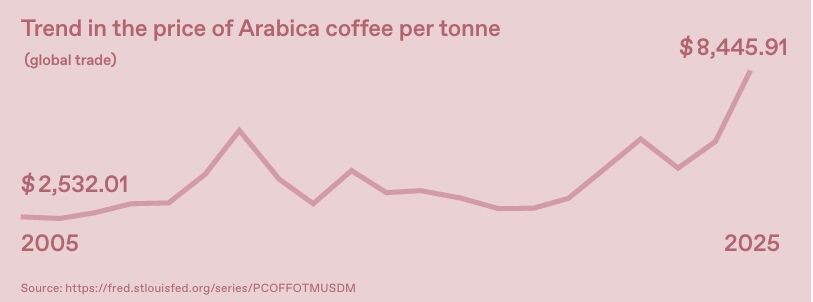
HAUKE: I naturally believe it is essential that the price ensures farmers have the necessary in come level – and I’m speaking for ourselves and our own plantation too. An economically viable and fair price would solve many problems in the medium term. But what farmers also need is predictability, not these extreme price fluctuations. In the cocoa market, the price has quintupled within 24 months – with the risk of plummeting just as quickly again.
Will we still have coffee and cocoa in 30 years’ time?
HAUKE: A definite yes, at least for cocoa.
PABLO: … And for coffee too, in any event. But it’s not a given. There’s a lot to be done. Above all, we need new coffee varieties, significant invest ment in adapting cultivation systems, functioning market mechanisms and so on – in other words, the issues we’ve been discussing today. There’s a lot to do, but there are certainly solutions.
HAUKE: We’re seeing just how important it is for a company to have the right expertise and the depth of understanding to delve into its supply chains. Only then can you identify the levers and mechanisms you can act upon. If you buy your raw materials anonymously from somewhere, you run the risk that they’ll eventually become scarce or no longer be available in the qualities your company requires. For me, this is the key message to our in dustries: Closely examine your supply chain! Go where it hurts! As a company dependent on raw materials, you must understand your supply chains from the ground up; otherwise, you won’t be able to exert the necessary influence.